GuideLinux · From a terminal
Set up Naytto on a Linux computer from a terminal
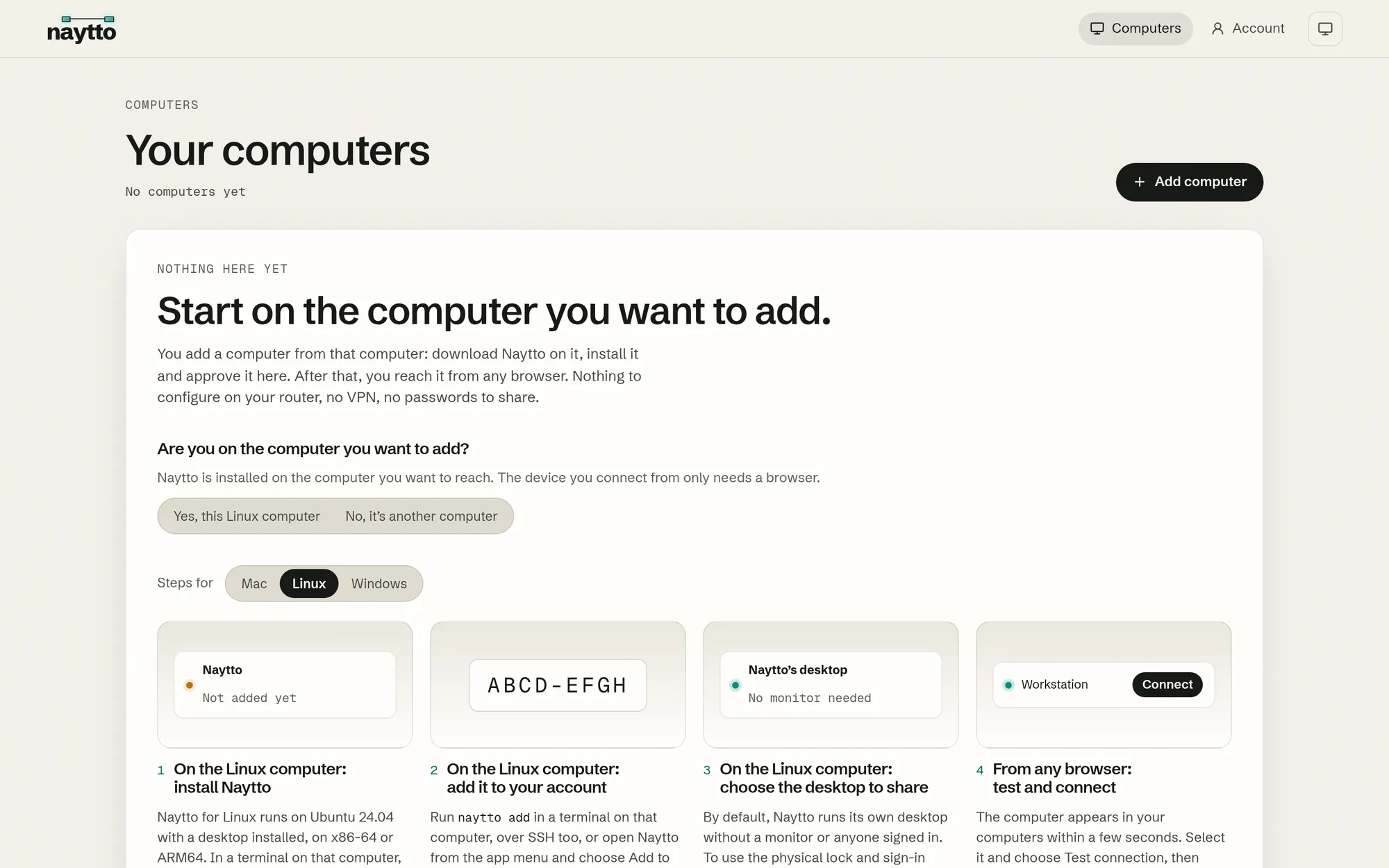
For an Ubuntu 24.04 computer you set up from a terminal, at the computer itself or over SSH, even a server with no desktop. One command installs Naytto, and a desktop if the computer has none. You approve the computer in a browser, type yes in the terminal, then connect from a browser on another device. It takes about 20 minutes, most of it installing the desktop.
Before you start
- A computer with Ubuntu 24.04, on x86-64 or ARM64, with or without a desktop, and a user on it who can use
sudo. It needs no monitor. - About 4 GB of free disk space if it has no desktop yet.
- A terminal on the computer: at the computer itself, or over SSH from another computer.
- An email address. If you don’t have a Naytto account yet, your first sign-in creates one and starts your free 14-day trial.
- A passkey or an authenticator app for your account. If you have neither, your browser offers to save a passkey when you approve the computer.
- Another device with a browser, such as a laptop, tablet or phone, to approve the computer and to connect from.
The same command is on the download page. Sitting at an Ubuntu computer with a desktop and rather not use a terminal? Follow Set up Naytto on a Linux computer instead.
Install Naytto
One command downloads Naytto, installs it with what it needs, offers a desktop if the computer has none, then starts adding the computer to your account.
01Connect to the computer
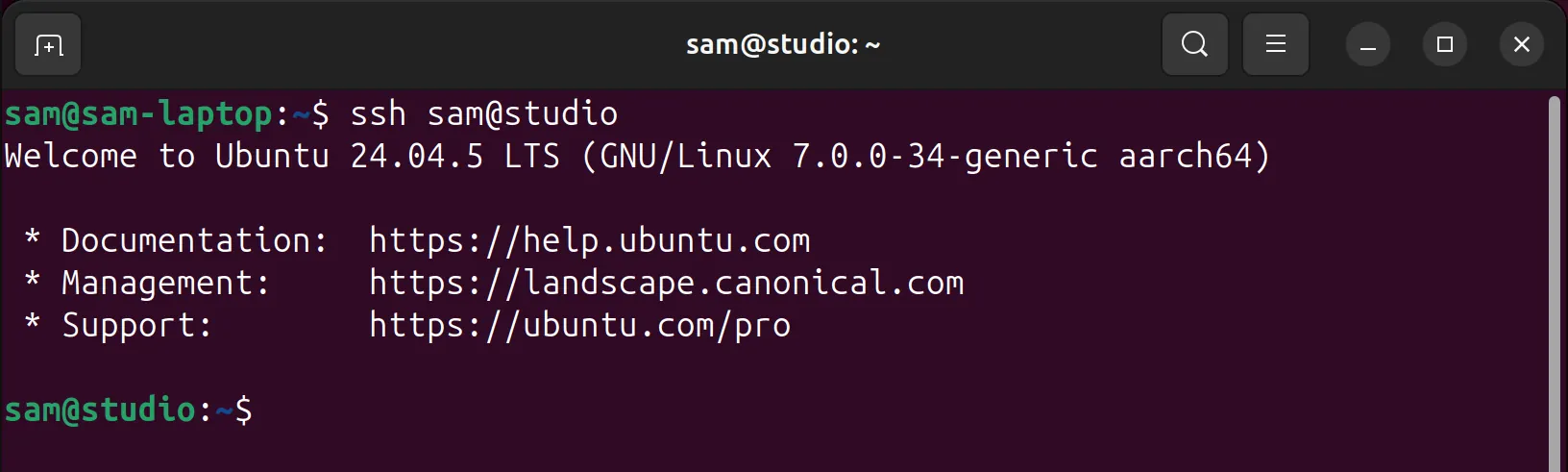
Open a terminal on your laptop and connect to the computer you’re adding, here named studio:
ssh sam@studio
Use your own user name and the computer’s name or address, and sign in as yourself, not root: Naytto runs as the user who installs it. The first time, ssh asks you to confirm the computer’s fingerprint (type yes), then asks for your password unless you use a key. Once you see the computer’s prompt, everything that follows runs there. Sitting at the computer instead? Sign in and use its terminal.
02Run the install command
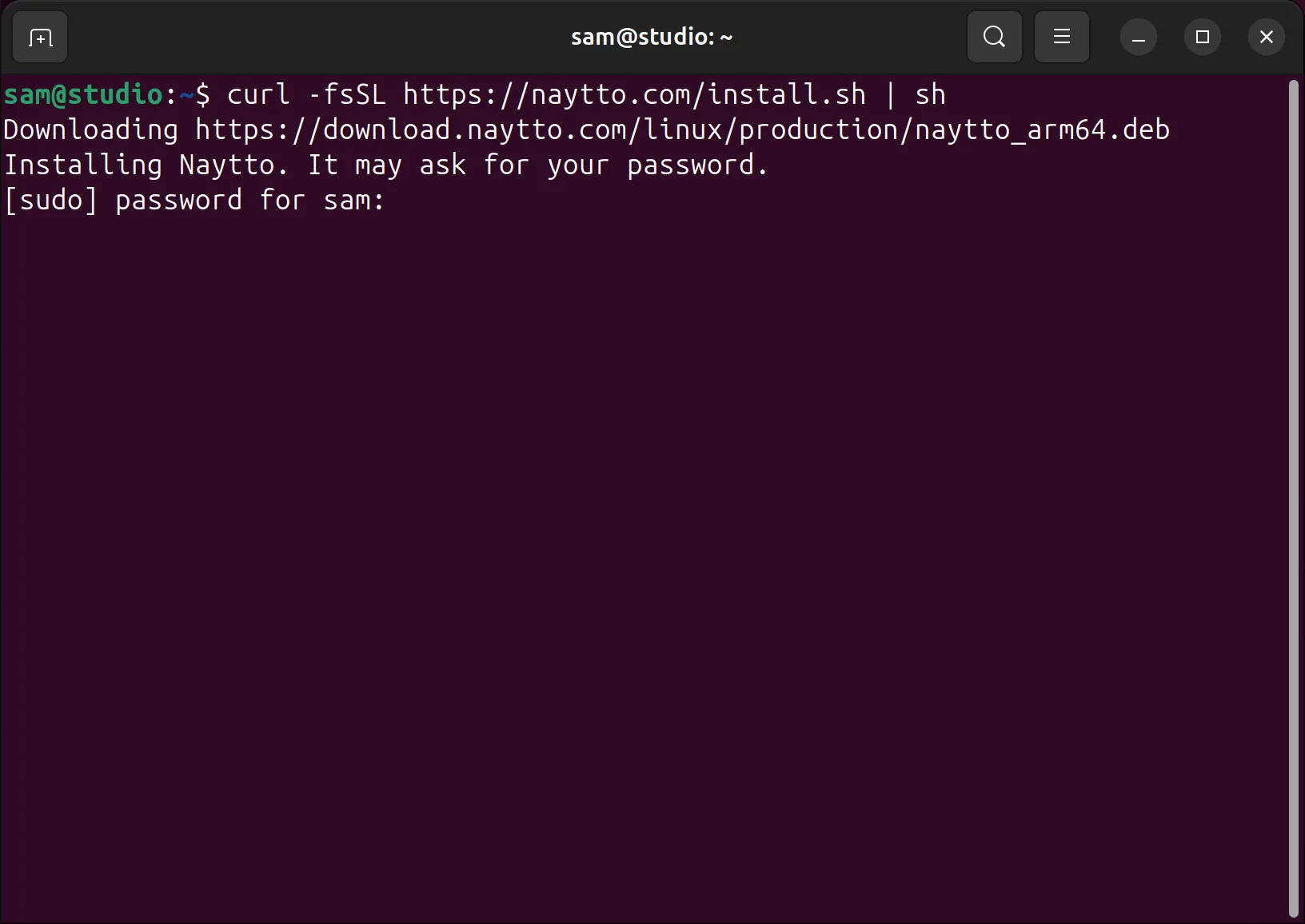
Paste this line and press Enter. When sudo asks, type your password for the computer.
curl -fsSL https://naytto.com/install.sh | sh
Downloading https://download.naytto.com/linux/production/naytto_arm64.deb
Installing Naytto. It may ask for your password.
[sudo] password for sam:
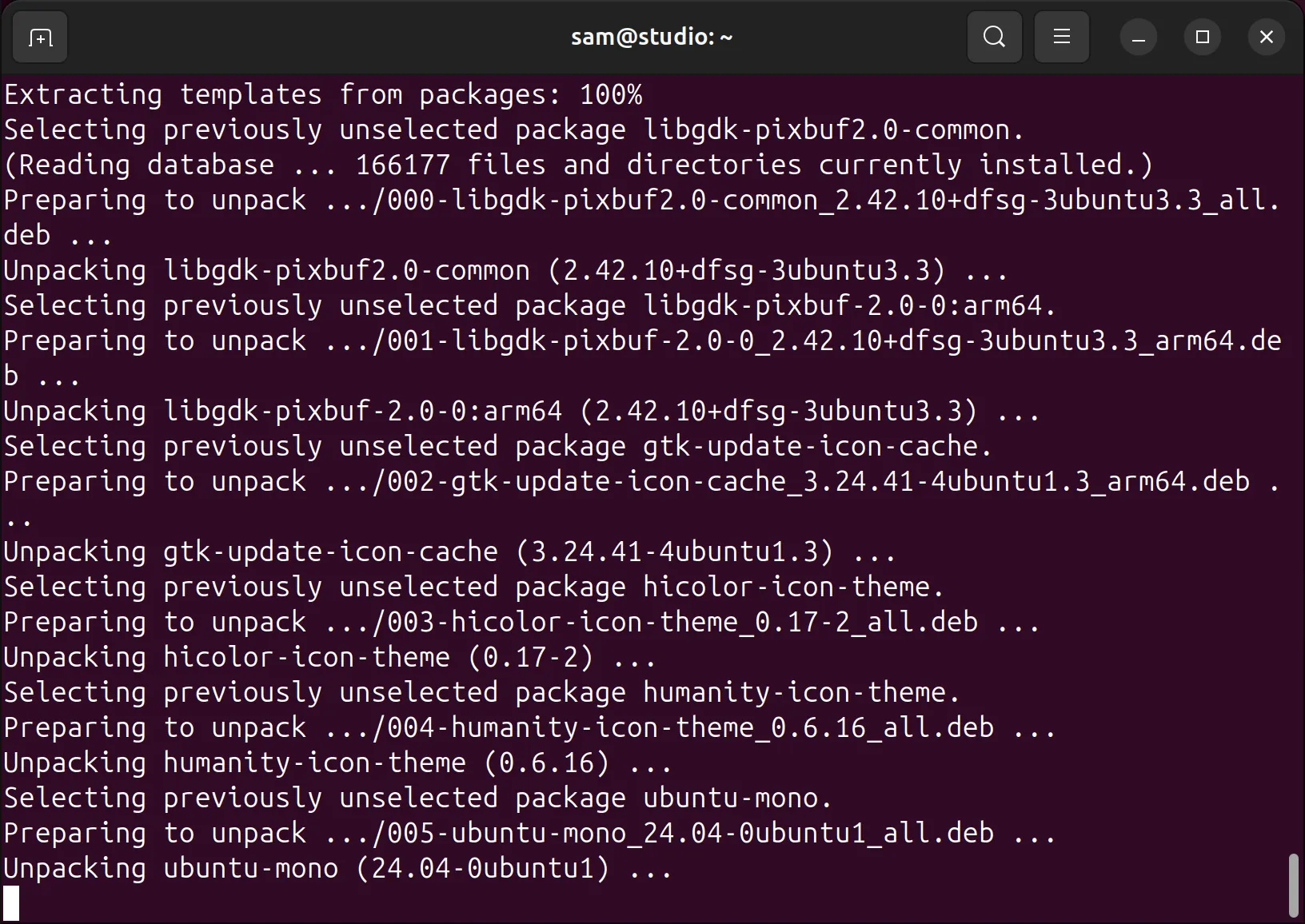
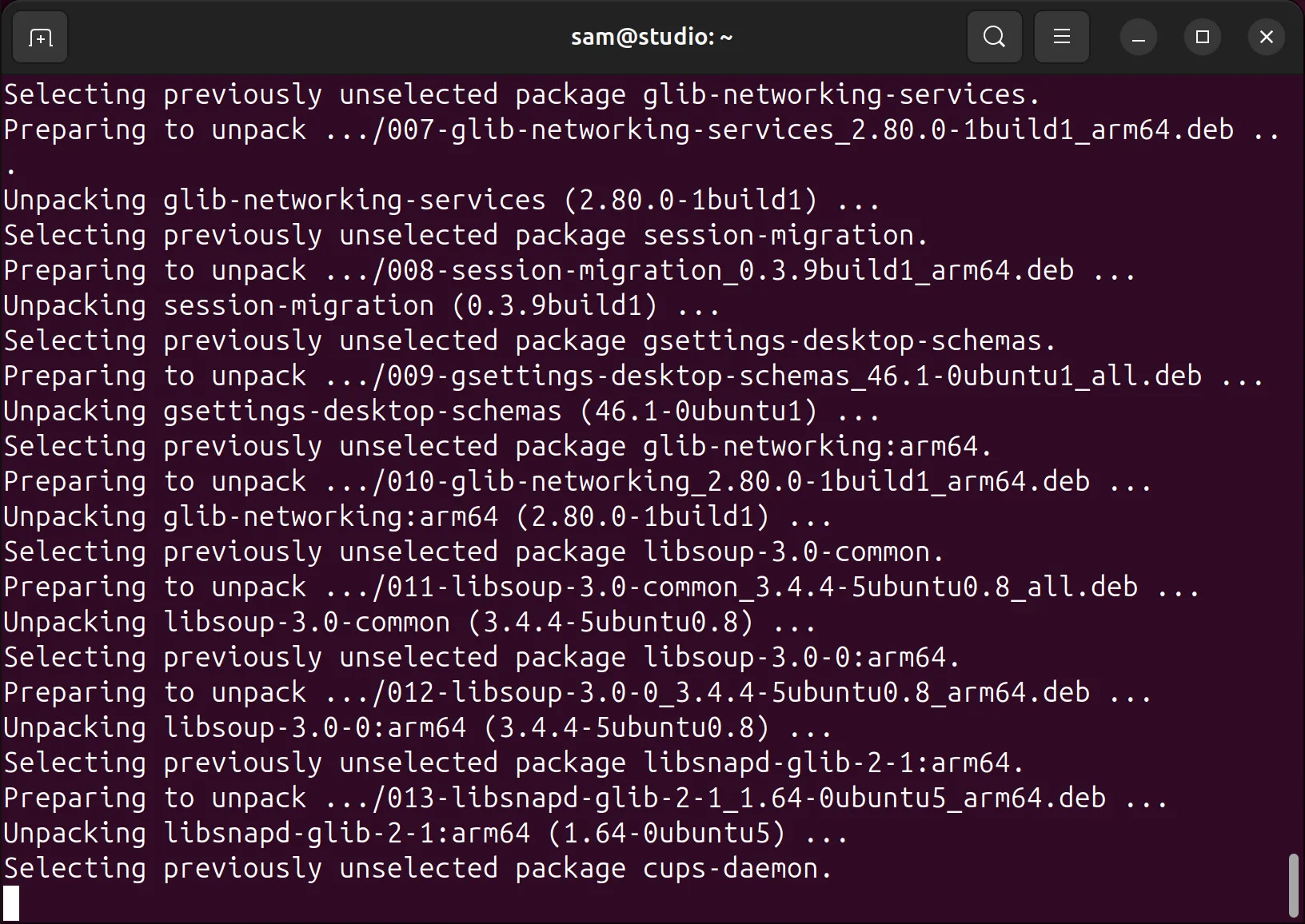
Ubuntu then installs Naytto and what it needs, 176 packages on a server with no desktop, and their lines scroll past for a few minutes. It ends with packages have been installed but needrestart is suspended, which is expected.
03Install a desktop
Naytto shows a desktop, so on a computer without one the installer offers Ubuntu’s minimal desktop. Type yes, or press Enter, to install it.
Naytto shows a desktop, and this computer doesn't have one installed. It needs no monitor: Naytto runs the desktop itself.
Install Ubuntu's minimal desktop now? [Y/n] yes
It’s 713 packages plus the Firefox snap and the runtimes it needs: about 1.7 GB to download and 3 GB of disk. Here it took about 11 minutes. If it takes longer than 15 minutes, sudo asks for your password once more at the end. A computer that already has a desktop skips this question.
![The terminal after Naytto installs, saying this computer doesn't have a desktop installed and asking Install Ubuntu's minimal desktop now? [Y/n], answered yes.](/guides/images/linux-terminal/05-install-desktop-yes.webp)
Add it to your account
The installer carries straight on: you approve a code in a browser, then allow your account in the terminal.
04Open the address it shows
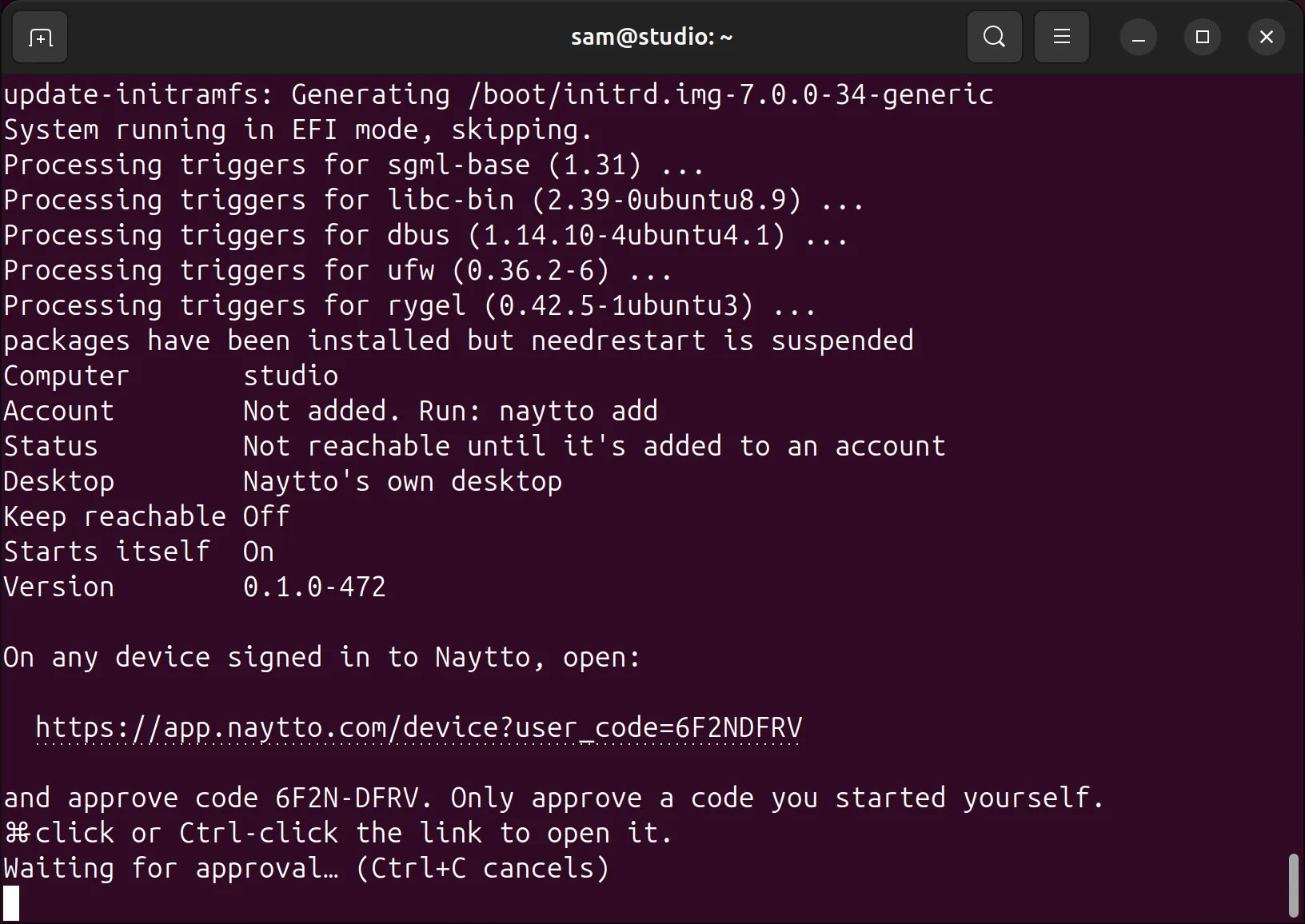
Once the desktop is in, the installer shows Naytto’s status, with Account Not added, then an address and a code:
On any device signed in to Naytto, open:

  https://app.naytto.com/device?user_code=6F2NDFRV

and approve code 6F2N-DFRV. Only approve a code you started yourself.
⌘-click or Ctrl-click the link to open it.
Waiting for approval… (Ctrl+C cancels)
Over SSH, the link opens in your laptop’s browser: ⌘-click it on a Mac, or Ctrl-click it elsewhere. You can also type the address on your phone. Leave the terminal open while it waits; the code works for 10 minutes.
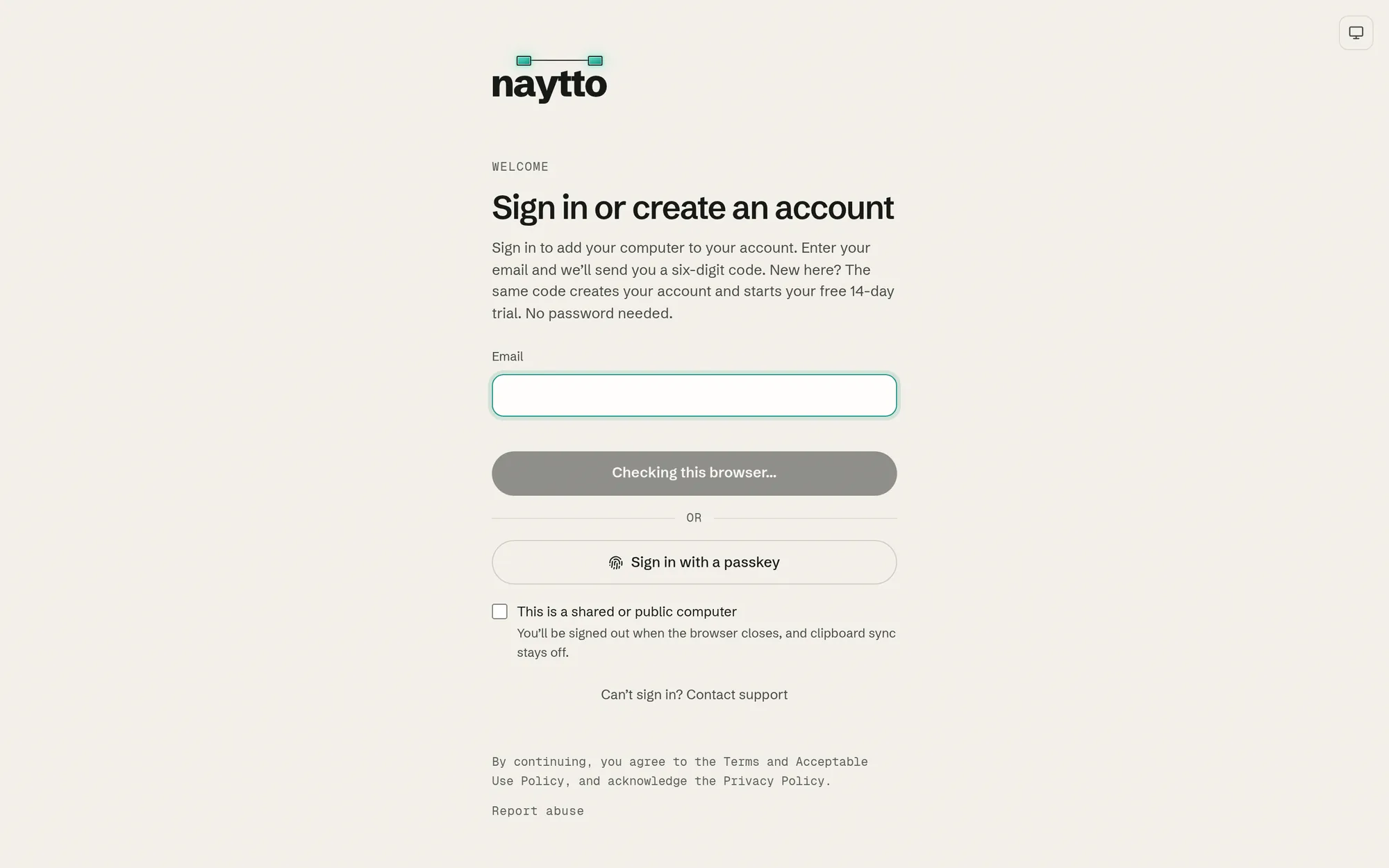
05Sign in with your email
If that browser isn’t signed in to Naytto, it asks you to. Type your email address and choose Email me a code. The button reads Checking this browser… for a moment first; if a Verify you are human box appears, tick it. New to Naytto? The same code creates your account and starts your free 14-day trial. A browser that’s already signed in goes straight to step 07.
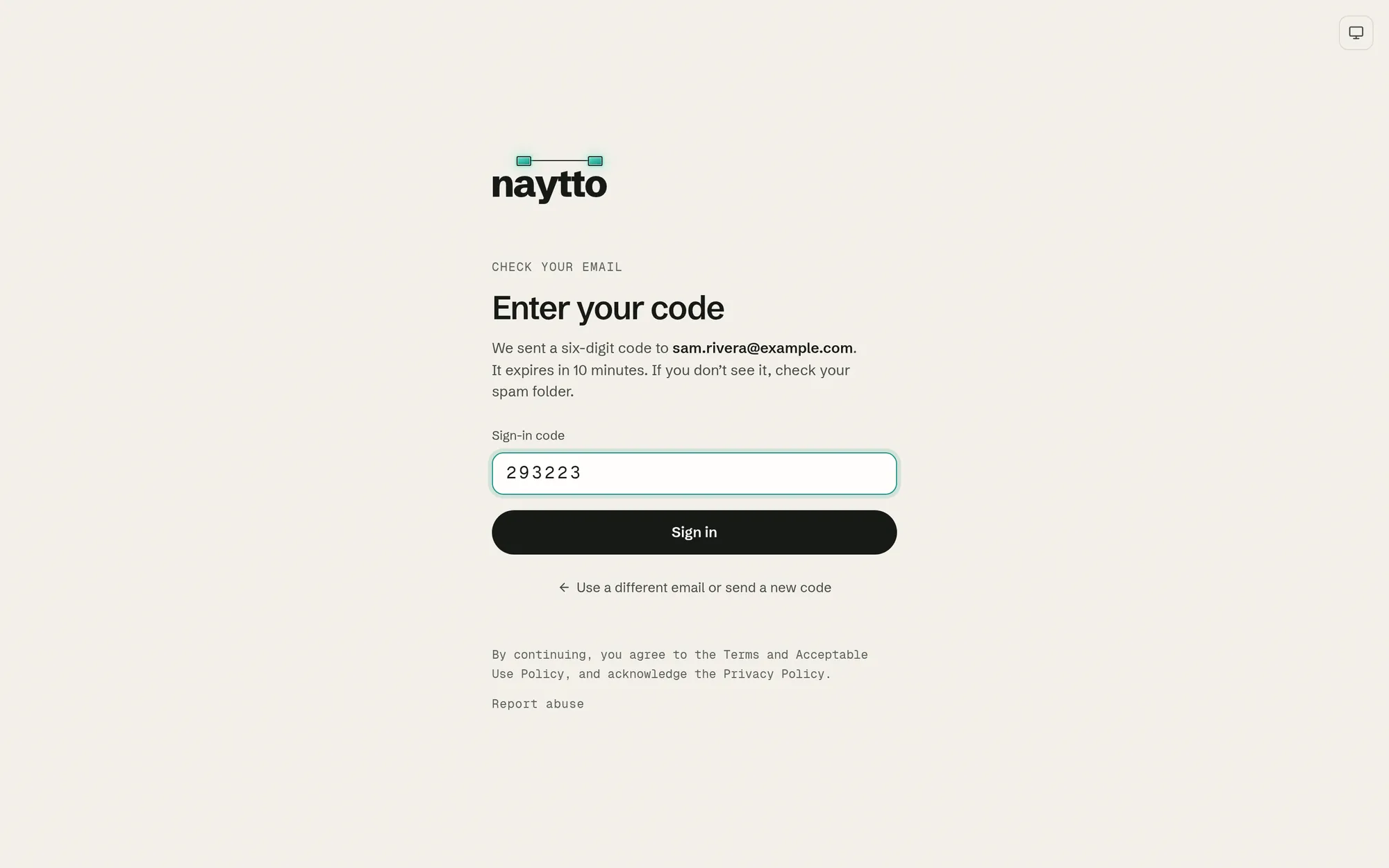
06Enter the code from the email
Naytto emails you a six-digit code; the subject line starts with it. Type it in Sign-in code and choose Sign in. The code expires in 10 minutes. If you don’t see the email, check your spam folder.
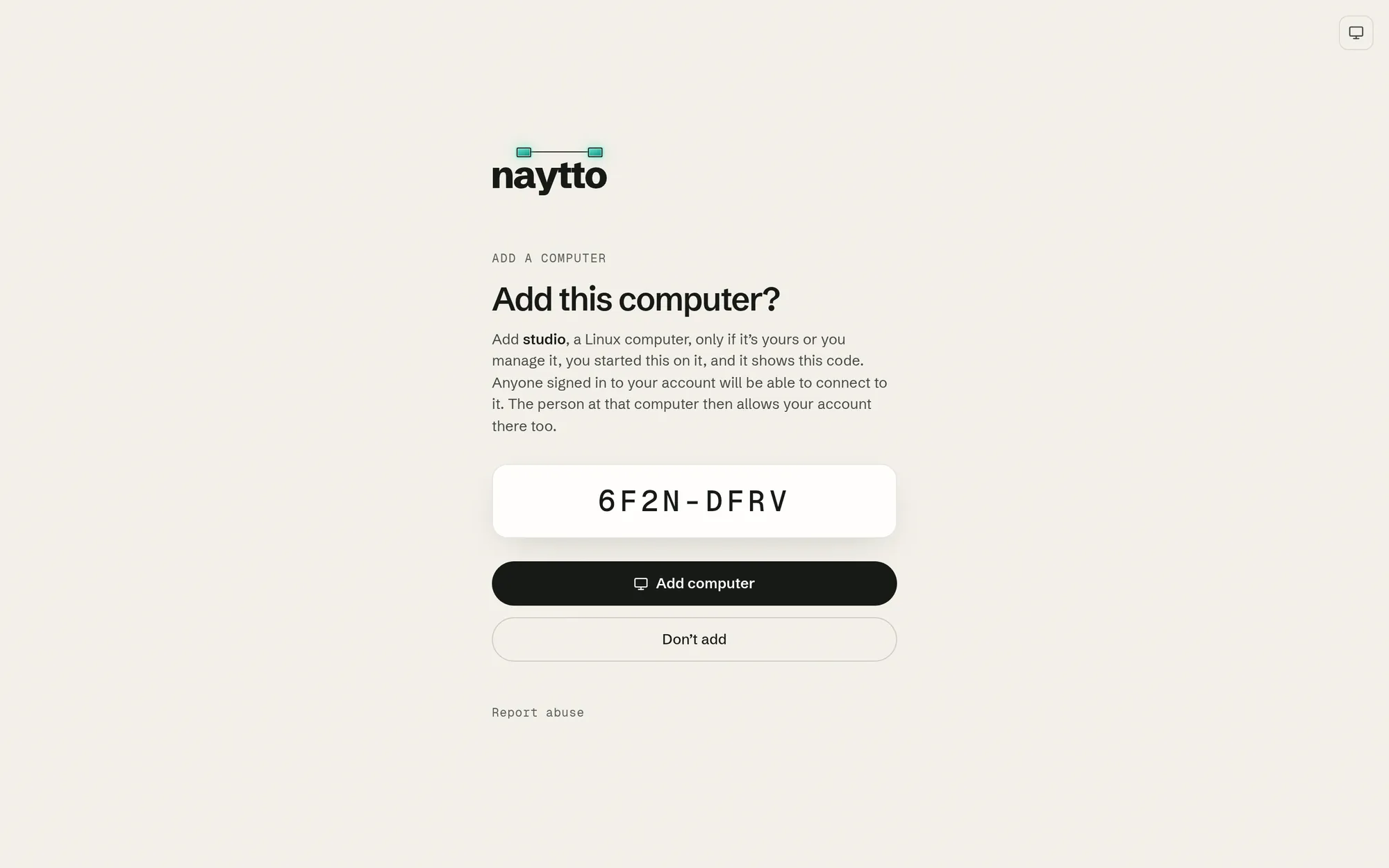
07Check the code and add the computer
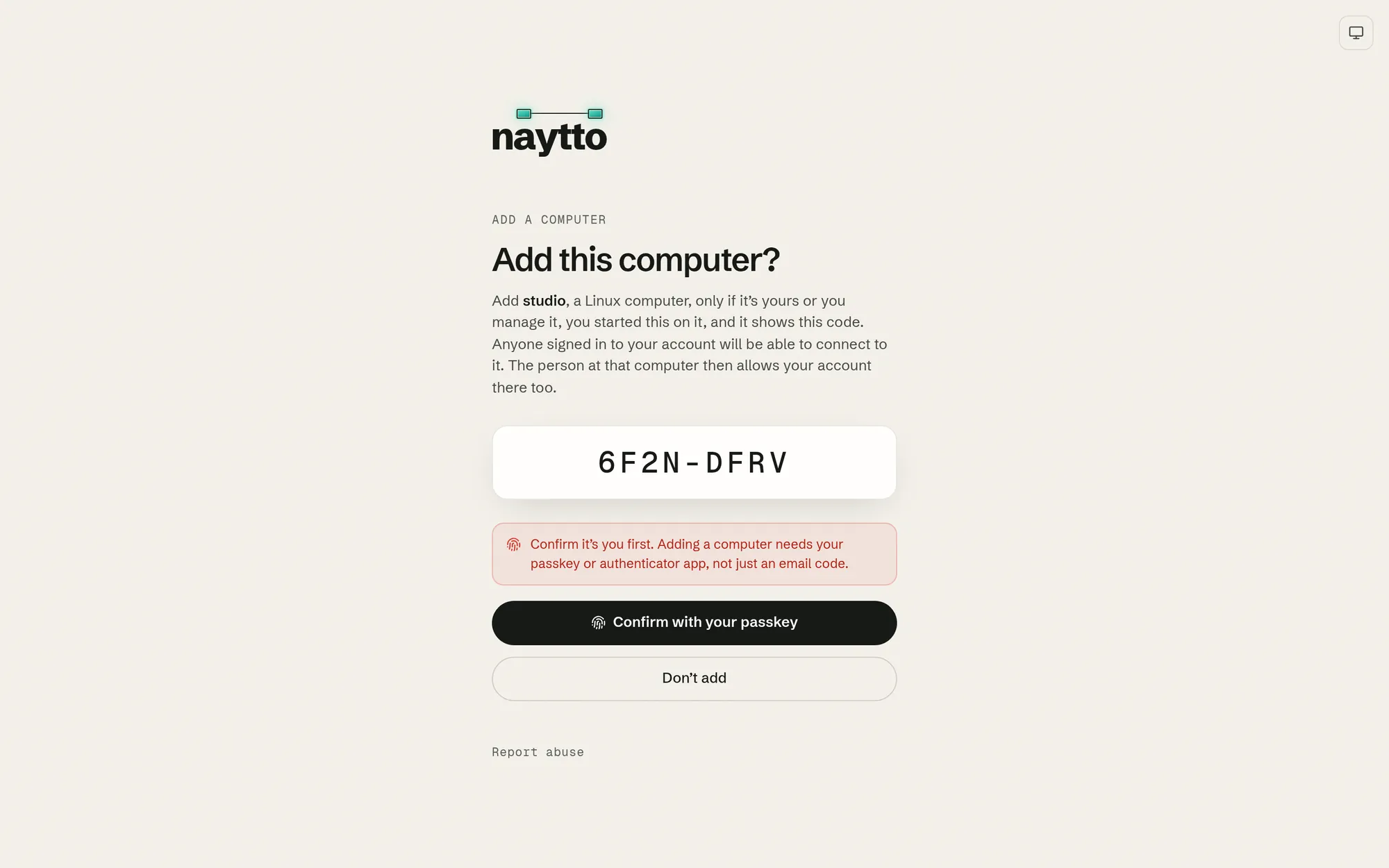
The page asks Add this computer? and names the computer, here studio. Check that its code matches the one in the terminal, then choose Add computer. Only approve a code you started yourself.
08Confirm it’s you
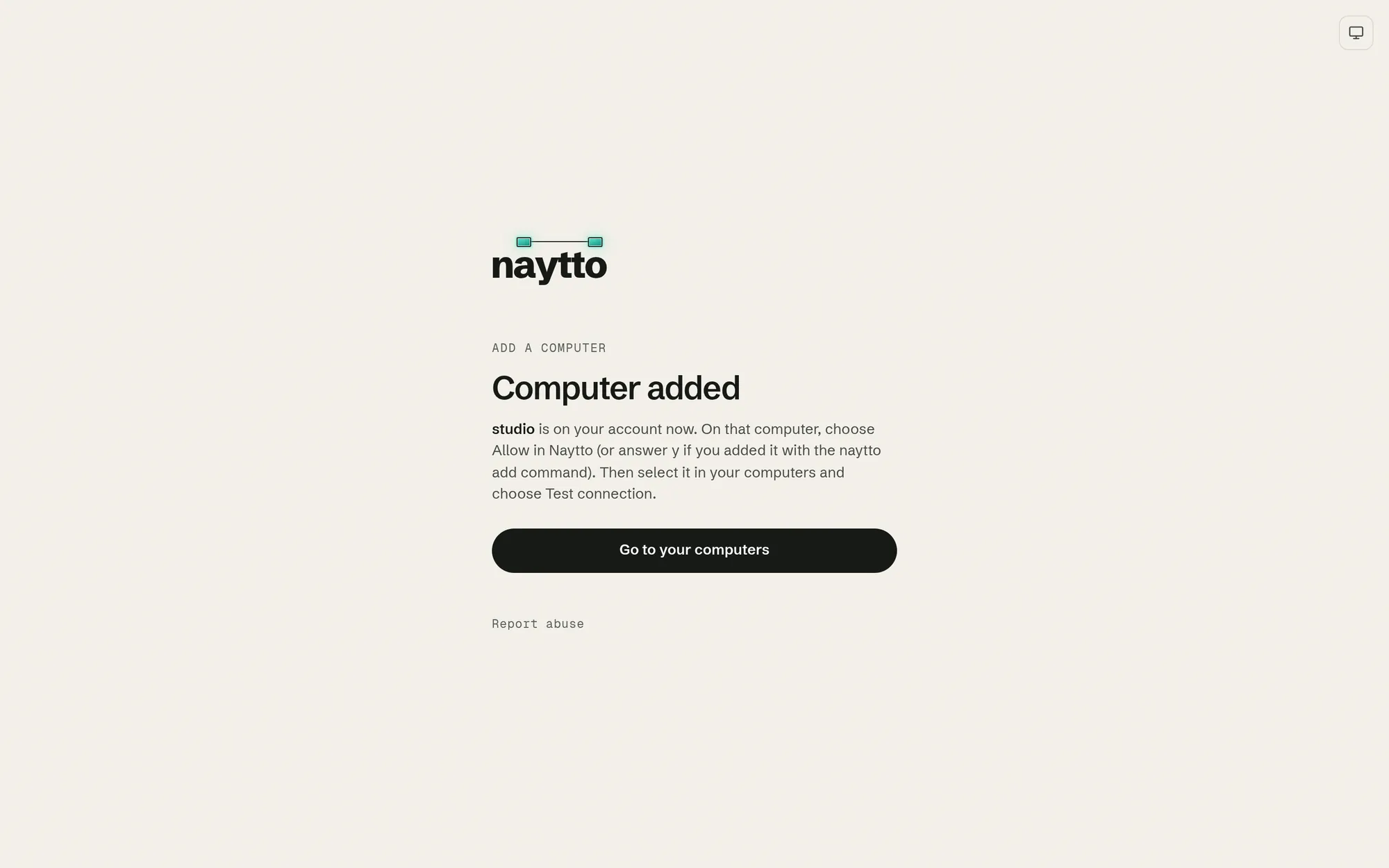
Unless you signed in with your passkey or authenticator app in the last 10 minutes, the page then asks you to confirm it’s you. Choose Add a passkey to confirm: your browser asks to save a passkey, then to use it. Accept both, and the page says Computer added.
Already have a passkey? The button reads Confirm with your passkey, and your browser only asks you to use it. With an authenticator app, you can choose Sign in again with your authenticator app instead.
09Type yes in the terminal
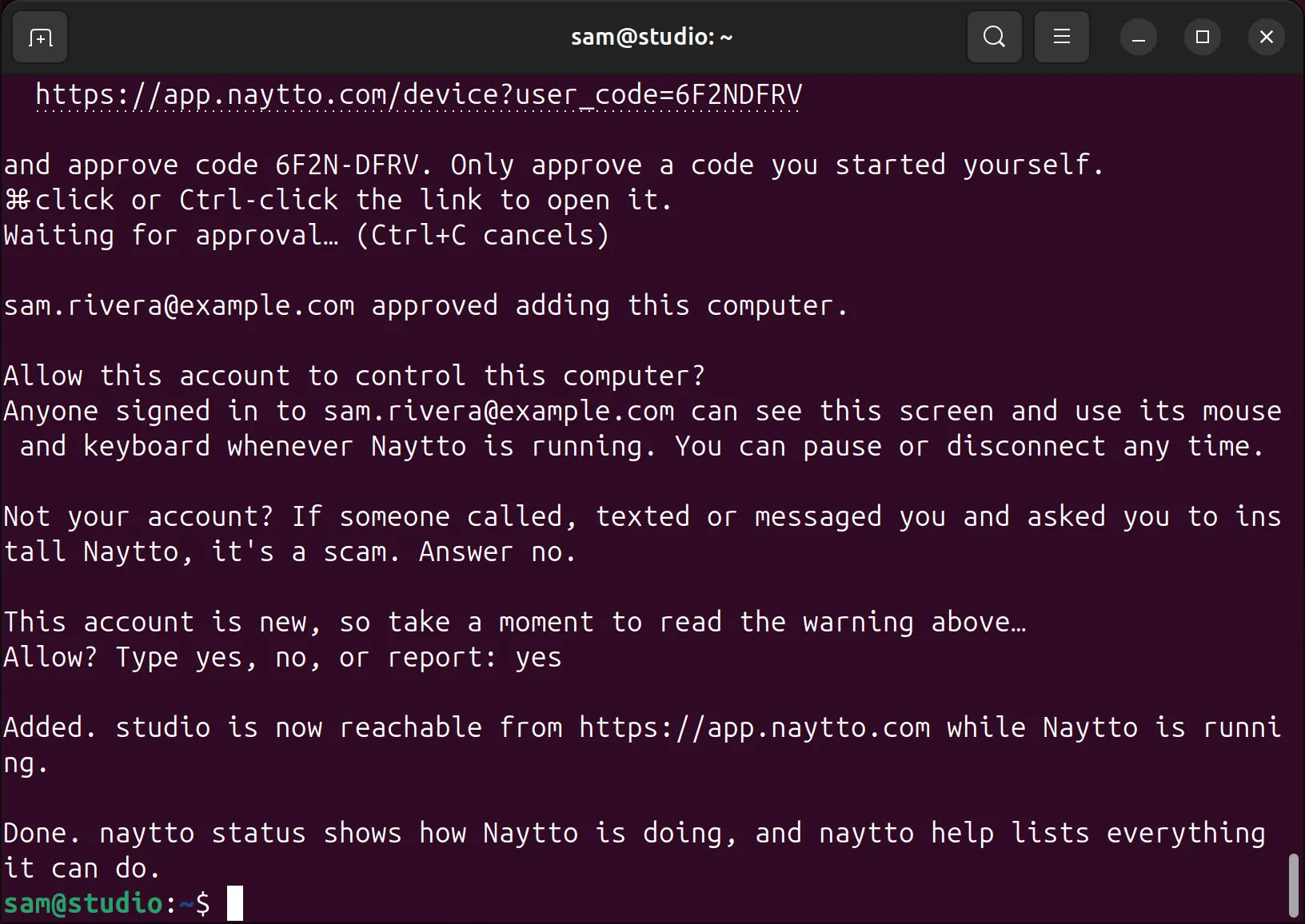
Back in the terminal, Naytto says who approved the computer and asks Allow this account to control this computer? Check that the email address is yours, then type yes and press Enter. The web page says to answer y, which works too. For a new account, Naytto waits a few seconds before it asks, so you read the warning.
Allow? Type yes, no, or report: yes

Added. studio is now reachable from https://app.naytto.com while Naytto is running.

Done. naytto status shows how Naytto is doing, and naytto help lists everything it can do.
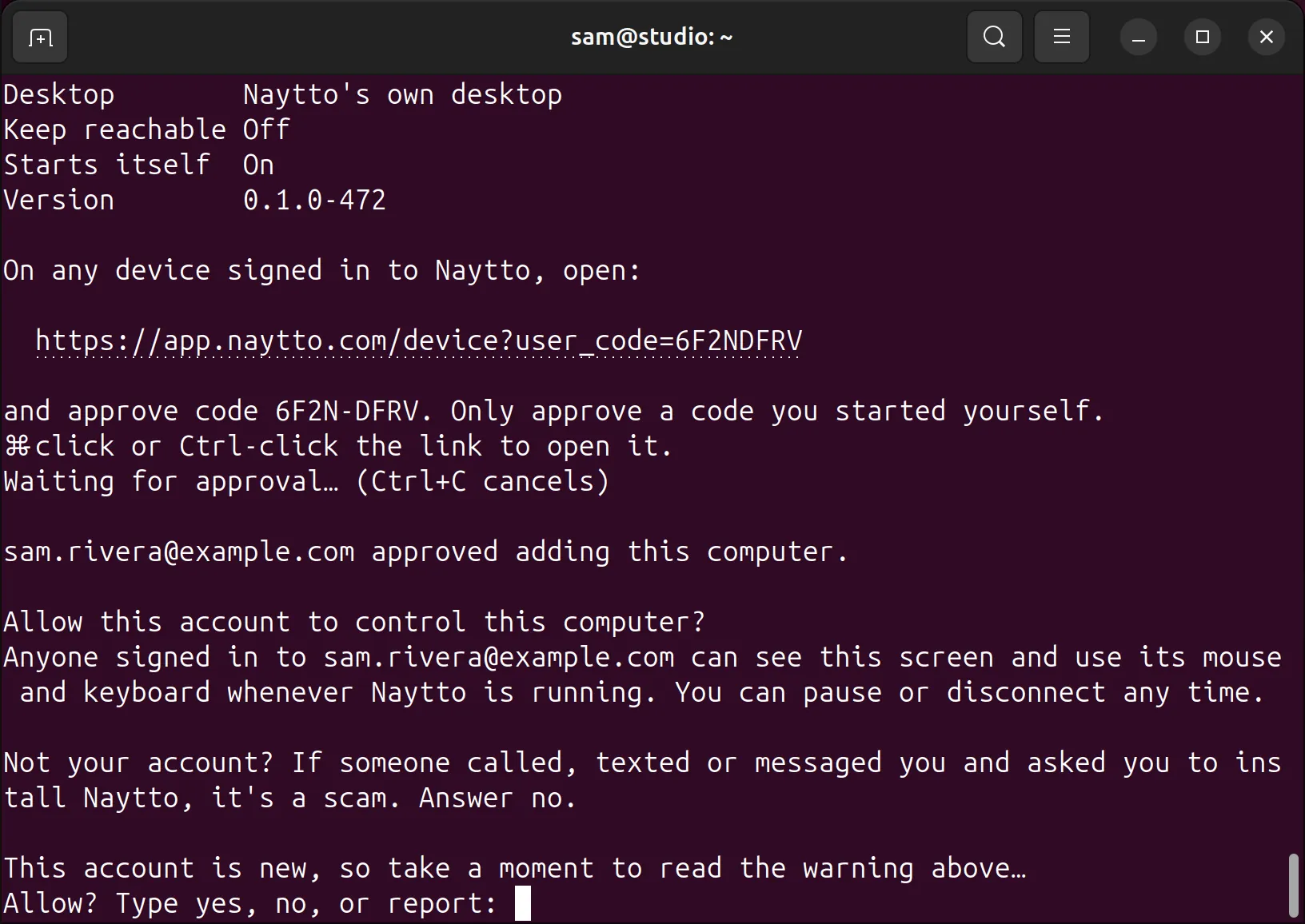
Only add your own computer. If the email address isn’t yours, or someone called, texted or messaged you and asked you to install Naytto, it’s a scam: type no, or report to have Naytto review the account.
10Check its status
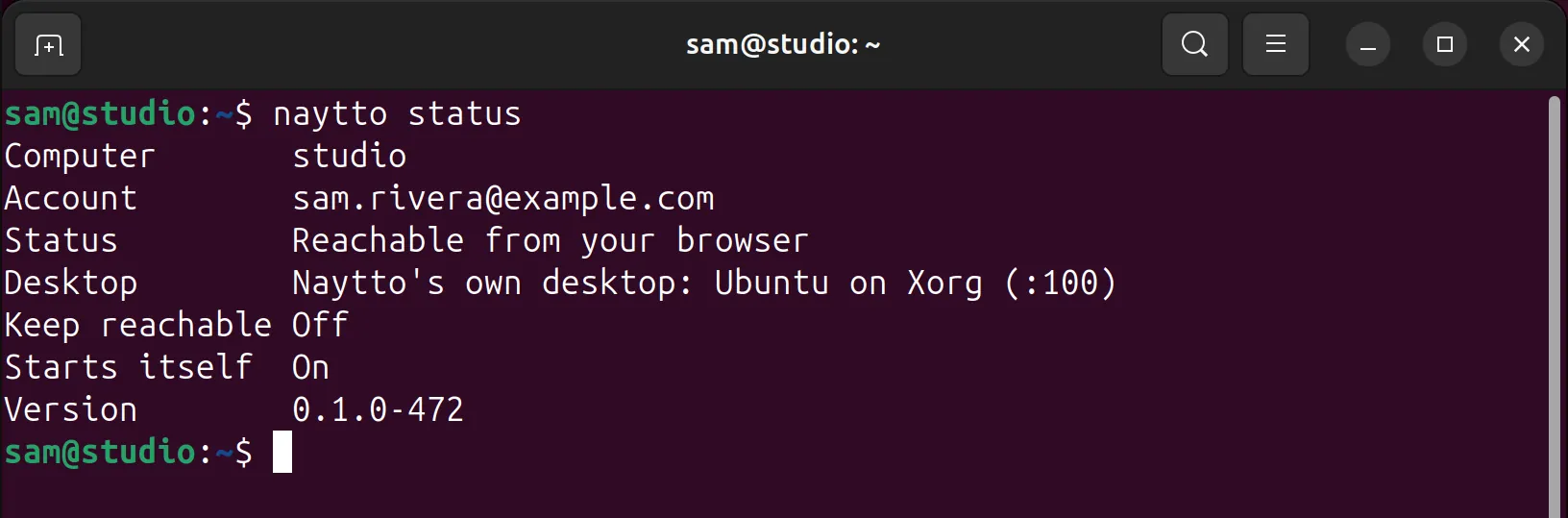
Run this whenever you want to know how Naytto is doing:
naytto status
Status says Reachable from your browser. Desktop says Naytto's own desktop: the Ubuntu desktop Naytto runs on a screen that exists only in memory, so the computer needs no monitor and no one signed in. Starts itself On means Naytto starts when the computer does, and it keeps running after you close SSH.
Connect from your browser
From here on, all you need is a browser.
11Choose Connect
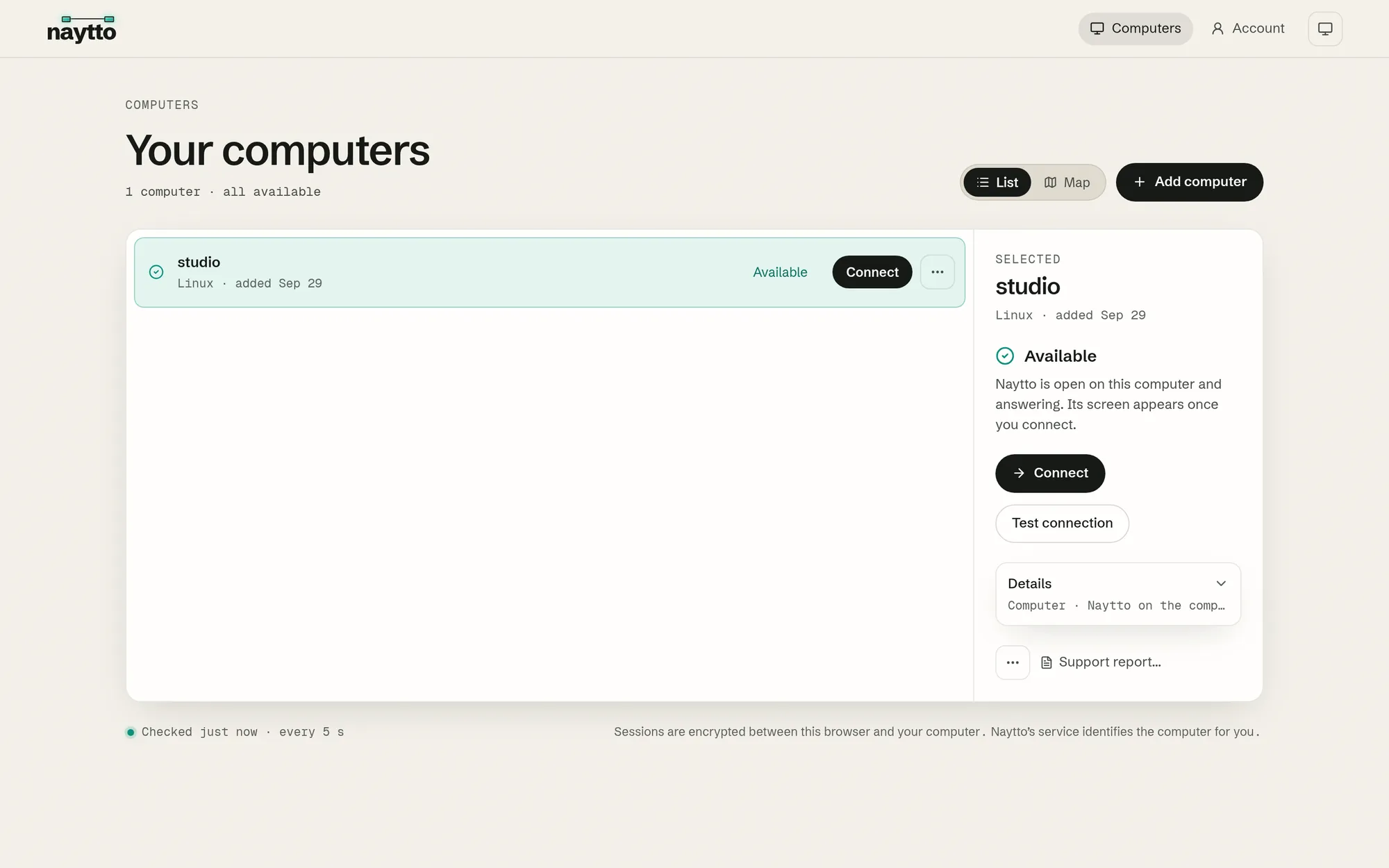
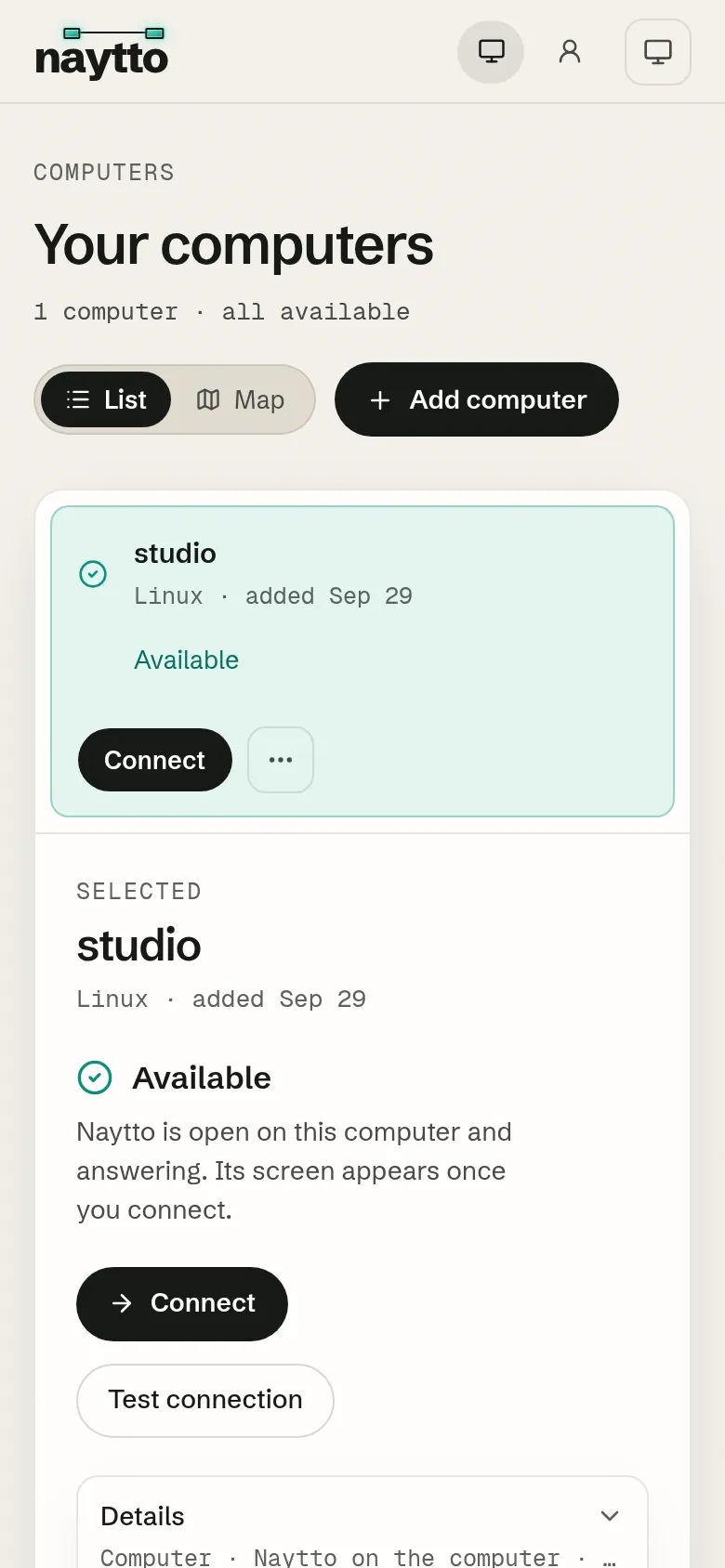
On another device, sign in at app.naytto.com, or choose Go to your computers on the page you’re on. Your computers lists the computer as Available: Naytto is open on it and answering. Choose Connect.
12Use its desktop
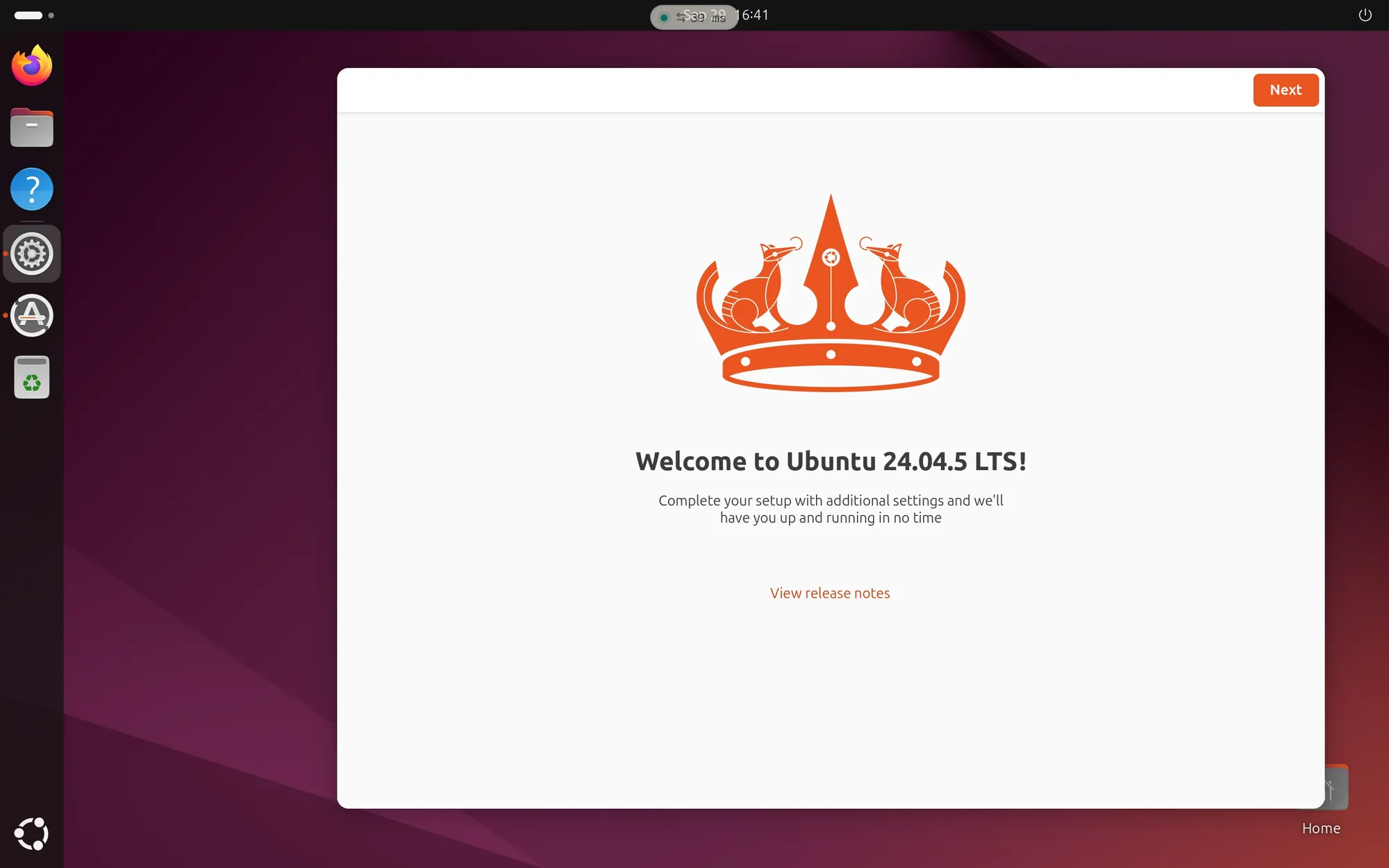
The computer’s Ubuntu desktop fills the tab, sized to your browser window. It keeps running between sessions, so apps you leave open are still there next time. Hold Esc to take the keyboard and pointer back from the computer. The pill at the top of the tab opens the session controls, including Disconnect.
The first time, Ubuntu’s welcome window opens, and Ubuntu may put System program problem detected on top of it. Choose Cancel, then Next to go through the welcome window’s pages.
13Test the connection
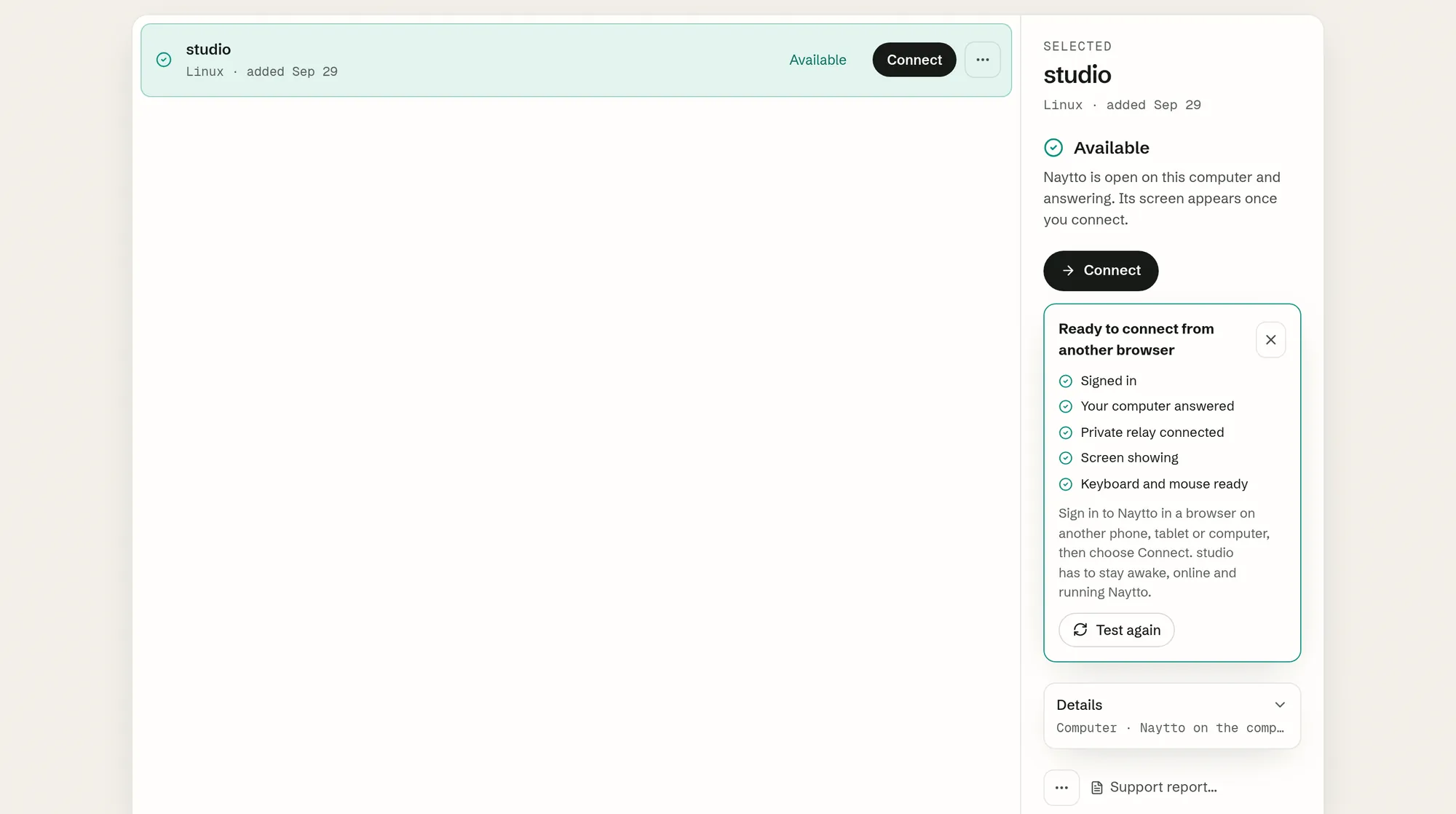
In your computers, select the computer and choose Test connection, then Start test. A short session checks sign-in, the private relay, the screen and the keyboard and mouse, then ends; nothing is typed or clicked. The Clipboard and File transfer checks are optional. After a few seconds it says Ready to connect from another browser, with a check beside each of its five lines.
14Connect from your phone
The same page works on a phone or tablet: sign in at app.naytto.com and choose Connect.
Every day
Naytto keeps running after you close the terminal and starts itself with the computer. It updates with the computer’s other updates, through sudo apt update && sudo apt upgrade or Software Updater, and restarts into the new version once no one is connected. Everything else is a naytto command, run on the computer, over SSH too.
15Pause remote access
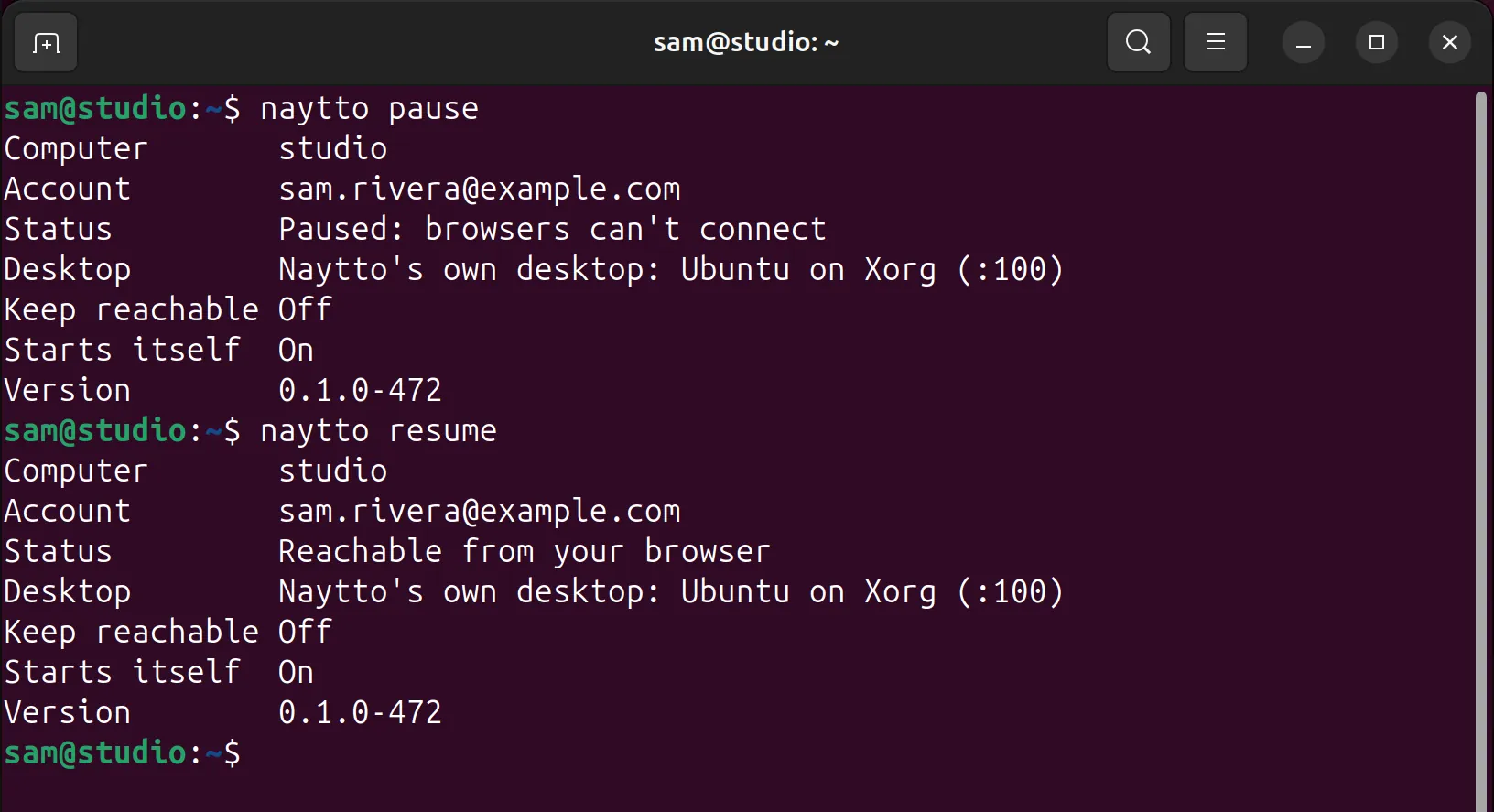
naytto pause
It prints the status, now Paused: browsers can't connect. In your computers, the computer shows Remote access paused with no Connect button. Only someone on the computer, at it or over SSH, can pause or resume. To let browsers connect again:
naytto resume
The status goes back to Reachable from your browser.
16End a session from the computer
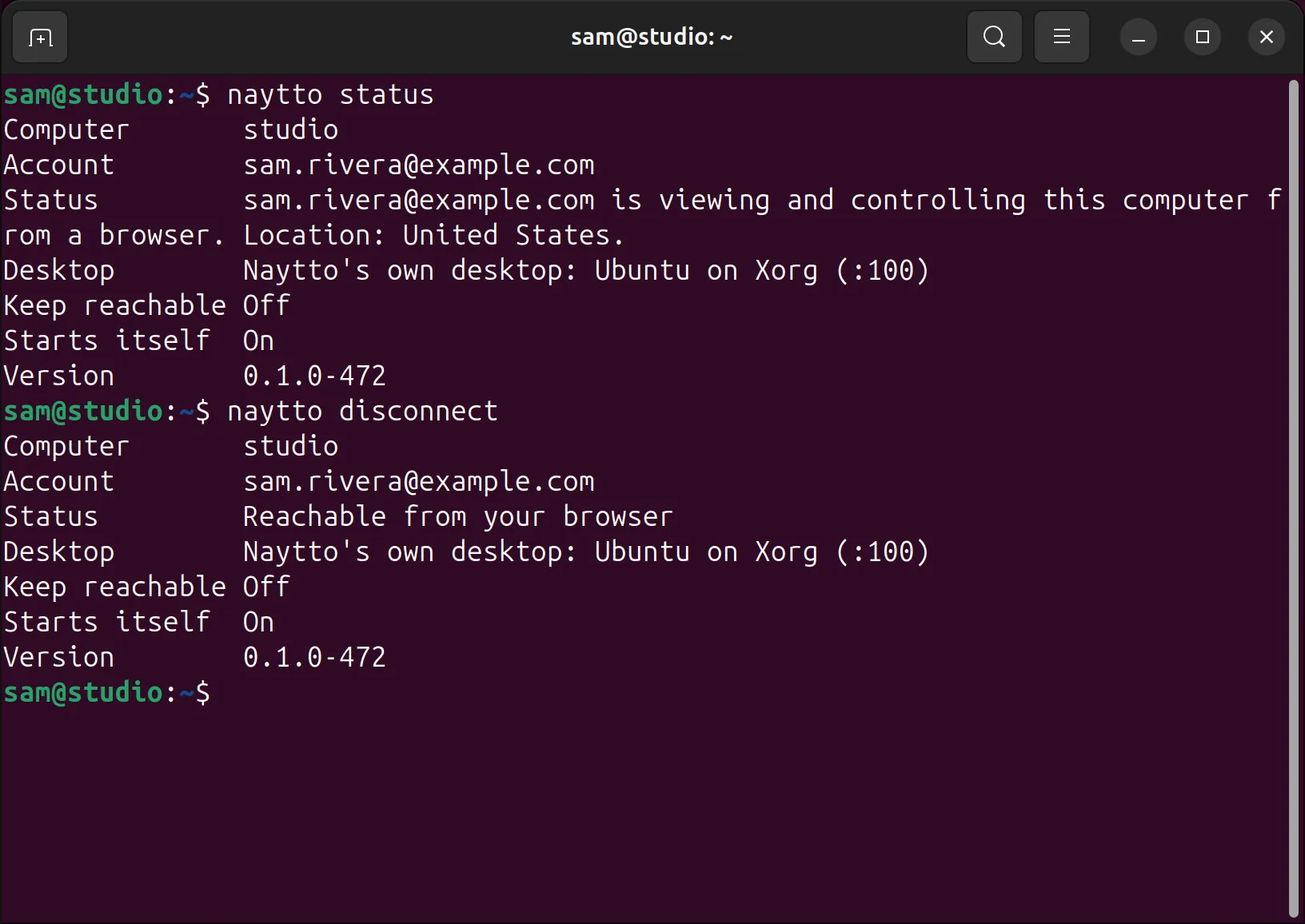
While a browser is connected, naytto status says who, and roughly where from: sam.rivera@example.com is viewing and controlling this computer from a browser. Location: United States. To end that session:
naytto disconnect
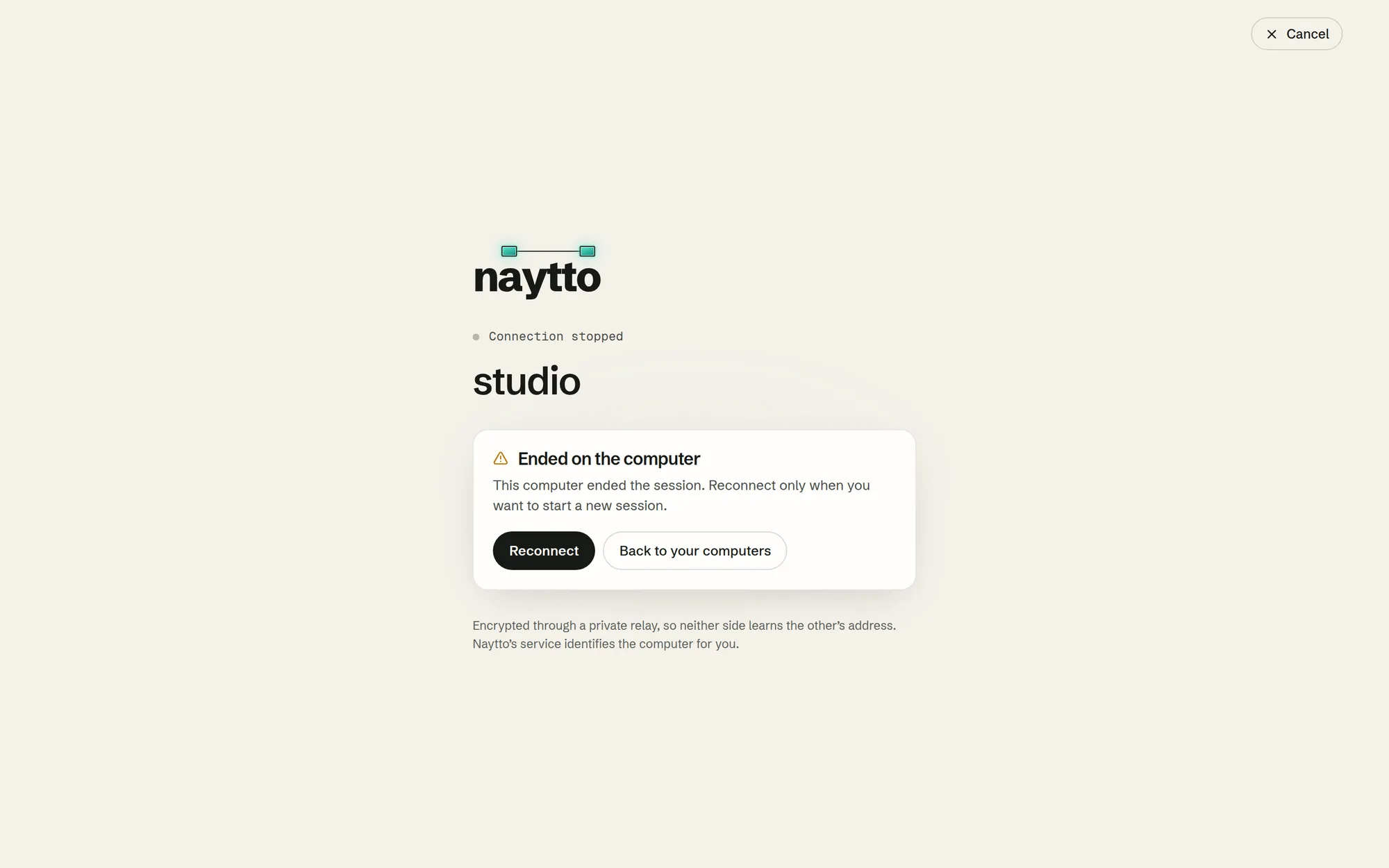
It prints the status, back to Reachable from your browser. The browser says Ended on the computer, with Reconnect and Back to your computers.
17Keep the computer reachable
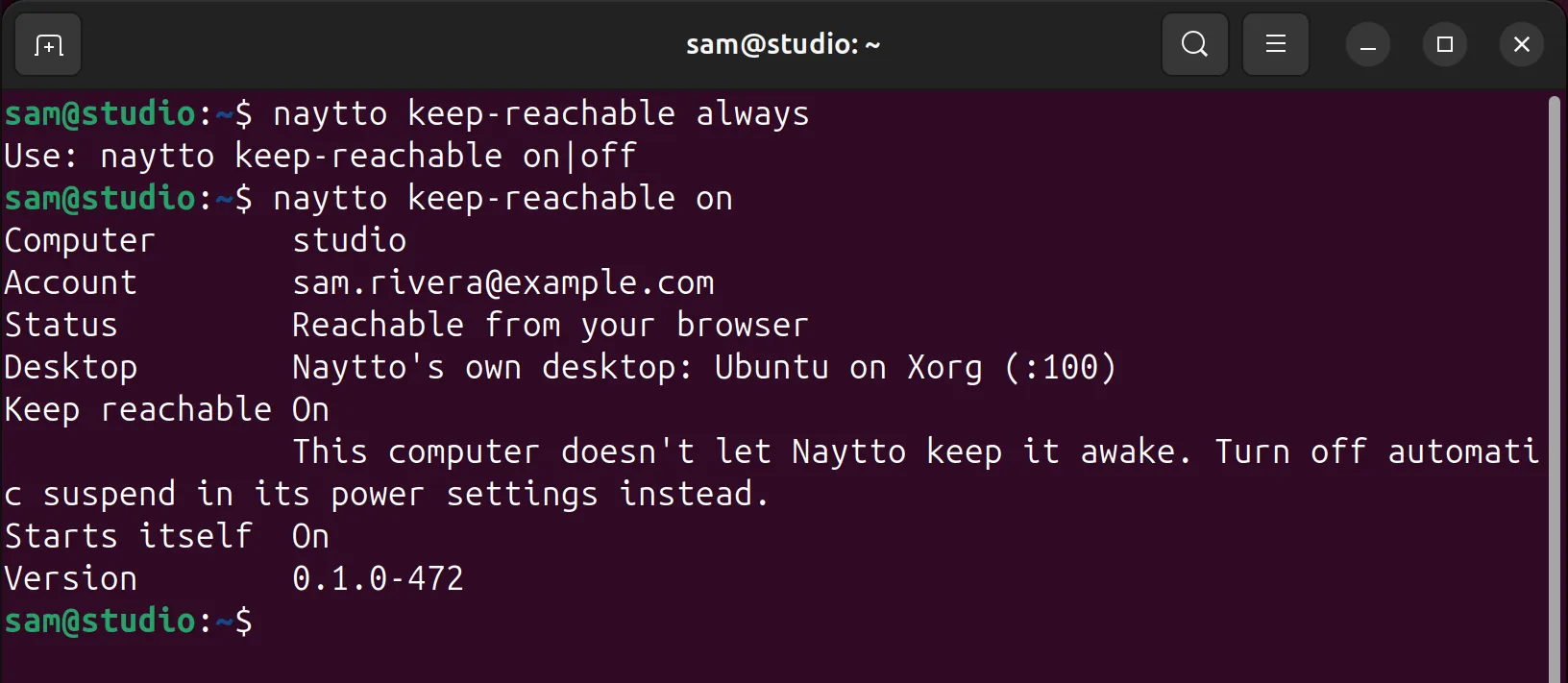
A computer that’s asleep can’t be reached. To stop it sleeping while Naytto runs:
naytto keep-reachable on
The words are on and off. Ubuntu allows it only for someone signed in at the computer’s own screen, so on a server it usually can’t, and the status says This computer doesn't let Naytto keep it awake. Then switch off automatic suspend in the computer’s power settings instead.
18See which desktop it runs
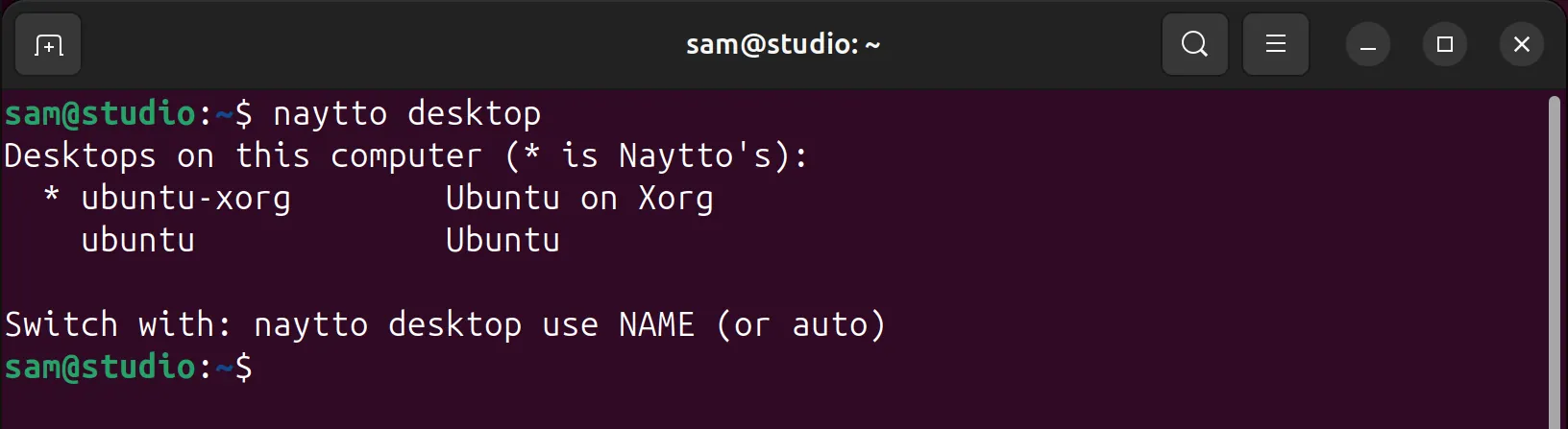
naytto desktop
It lists the desktops installed and stars the one Naytto runs, here Ubuntu on Xorg. To run another, use naytto desktop use with a name from the list. It asks first, because apps open on Naytto’s desktop close.
19See every command
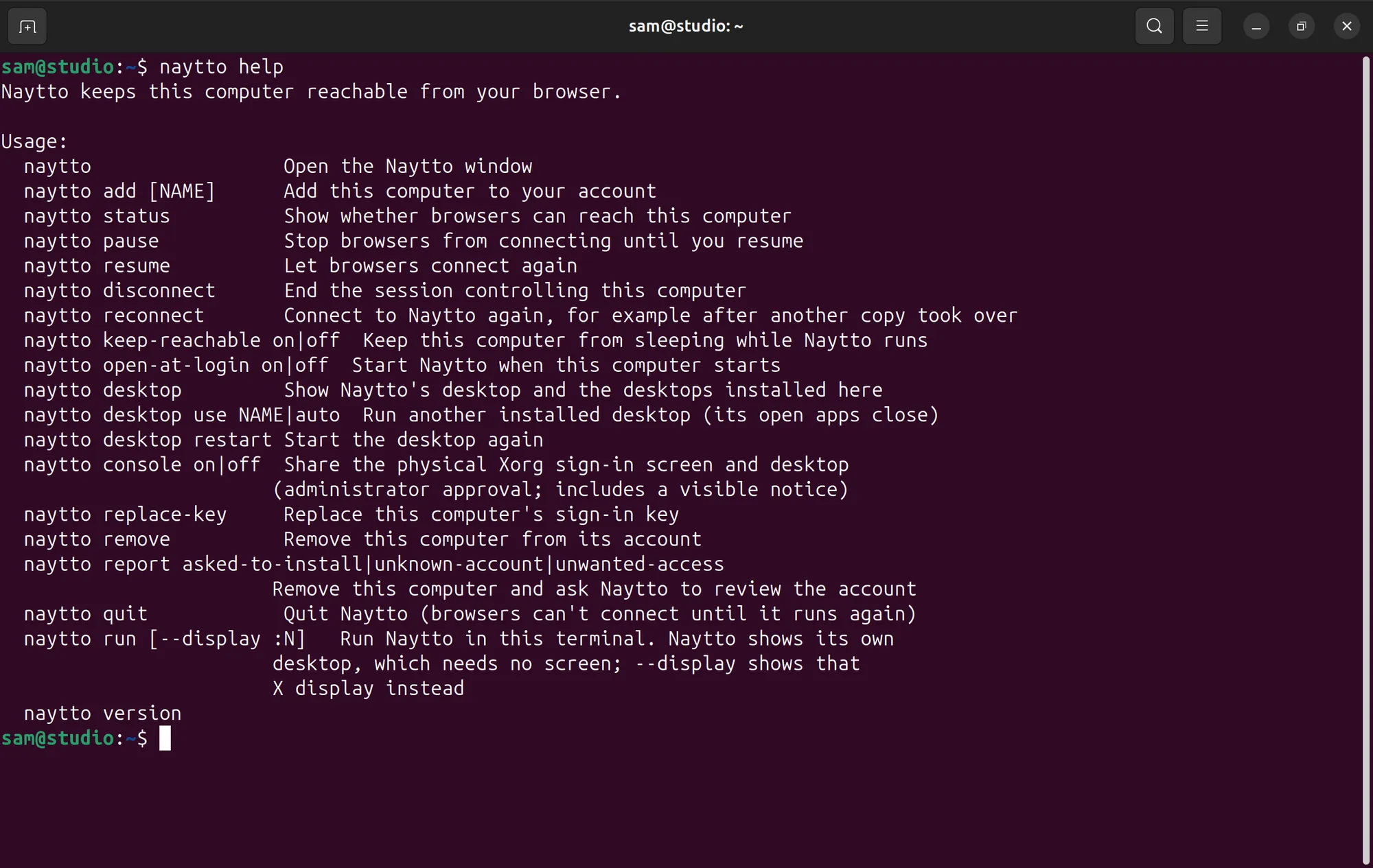
naytto help
It lists each command with a line on what it does. Among them, naytto open-at-login on|off chooses whether Naytto starts with the computer, and after naytto quit browsers can’t connect until Naytto runs again.
20Remove the computer from your account
naytto remove
It asks first, and the default is no. Type y and press Enter. It prints Removed. This computer can't be reached from your account any more. The status below it says Account Not added, and your computers no longer lists it. Naytto stays installed; to add the computer again, run naytto add.
Away from the computer? In your computers, in any browser, choose … next to it, then Remove from account; any session on it ends at once.
![The terminal after naytto remove, asking Remove this computer from its account? Browsers won't be able to reach it until it's added again. [y/N]](/guides/images/linux-terminal/27-remove.webp)
If something isn’t right
- The installer says to run it as the person whose desktop Naytto should show. You ran it as root or with
sudo. Sign in as your own user and run the command withoutsudo; it asks for your password when it needs to. - The connection dropped during the install. Connect again and run the install command again. If apt says dpkg was interrupted, run this first:
sudo dpkg --configure -a - The code ran out. It works for 10 minutes. Then the terminal says The code expired. Start again. Run
naytto addfor a new code. For a sign-in code that expired, choose Use a different email or send a new code. - Desktop not ready. Naytto can’t run its desktop on the computer yet, most often because none is installed, for example if you answered no in step 03. Install one with
sudo apt-get install -y ubuntu-desktop-minimal, then choose Check again in your computers. On the computer,naytto statussays what’s wrong. - Remote access paused. Someone paused it on the computer. Run
naytto resumethere. - Asleep, Not responding or Can’t reach. The computer is asleep, off or offline, or Naytto isn’t running on it, and Naytto can’t wake it yet. Wake it or check its network; while Naytto on the computer is offline,
naytto statusthere says Offline: reconnecting. If the status says Naytto starts when you sign in rather than when the computer starts, run the command it shows. To keep it awake, see step 17.
Still stuck? Get help from a person.